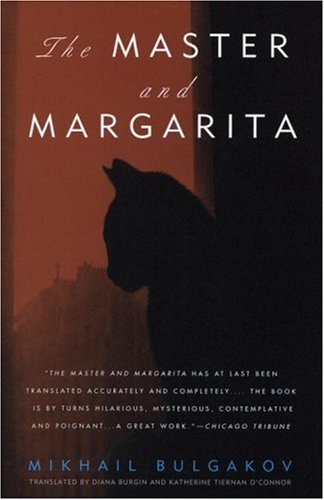
This is a pretty good book with an intriguing storyline, but ultimately it wasn't as engaging as I thought it was going to be. There were too many characters, too much subplot, and a little too much magic happening. I usually enjoy magical realism more, because it weaves in and out of reality and fantasy. This book just became too weird and magical at times.
But, I really liked the political and religious imagery and allegories. I think I might have enjoyed the book more if I better understood the judeo-christian references and hidden references to many Western literature classics.
I do want to point out that I really, really liked the ending. I am glad Bulgakov chose to end his novel on such a decisive, firm note, and the book redeemed itself to me a little with the last few chapters.
Priyanka Bhardwaj writes an damning article about rape and the overall patriarchal society in India. India is fast becoming an economic superpower, but the sub-par treatment and protection it offers its women places it firmly in the third world . This needs to stop; if there is change, it is not happening fast enough.
Interesting article in the NYT today about how Bollywood movies have the potential to be appealing to American audiences. I have often thought about the possibilities of Hindi cinema, especially since it has graduated from the classic love and family drama in the 1990s to a grittier, more complex art today. The NYT article sums this up quite accurately:
It also helps that the definition of Bollywood has become more elastic. No longer a monolithic style that denotes stars, songs and melodrama, Bollywood has also come to encompass something else; over the last decade new filmmakers have tweaked the traditional form so that Hindi cinema also includes films without songs that are stark and rooted in contemporary Indian realities.
The movies from the 1990s were appealing to much of Southeast Asia, Africa, and the Middle East for their family values and conservative clothing, but things are likely to change as the themes get more contemporary and the clothing becomes racier, shifting some of the fan-base to western audiences. In many ways, this shift mirrors the change that India itself is going through, as it slowly leaves behind the developing world and joins the ranks of economic superpowers.
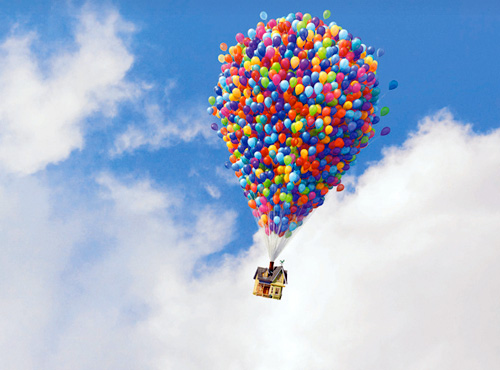
In celebration for the Oscars and of my favorite animated movie this year, I made Up-Cakes. These are mint cupcakes with a cream cheese frosting, topped with some sweetened coconut for the fluffy, sky-like effect and of course some Tootsie Pops to make the balloons that propelled Mr. Frederickson's house in the air.
The New Yorker has published a fascinating profile of Paul Krugman, New York Times op-ed columnist, professor at Princeton University, and winner of the Nobel Prize for Economics in 2008. You know, the usual.
The article is really long, but it is effective in explaining Krugman's evolution from an academic economist doing mainly research to a political economist who tries to explain complex economic theories in layman's terms every week in the NYT.
Some interesting parts that stood out to me were: 1) His wife: Krugman and Wells met while she was a post-doc at M.I.T., which already says a lot, and she edits all his columns. They are also co-authors on an undergraduate textbook that is coming out shortly, and sound like a really intelligent, balanced couple. She also sounds awesome. 2) His shift from economics to political economy: it sounds fairly obvious to most people now that economics and politics can be very intrinsically linked, but Krugman seems to have "fallen" into the political track rather than actively switched over. 3) The distinction made between "freshwater" and "saltwater" economists: I have never heard this before, and I wonder if the theorists who make this geographic distinction attribute it to anything other than coincidence. Are there geographic factors that would explain these different schools of thought?
Freshwater economists—who live near lakes, particularly at the University of Chicago, but also in Rochester and Minneapolis—are more likely to insist that macroeconomics be based on microeconomic foundations, which is to say that one should study large phenomena like recessions and inflation as functions of the behavior of many perfectly rational individuals.[...] Saltwater economists—who are to be found in coastal areas, especially at M.I.T., Harvard, and Berkeley—are more likely to allow that, at this stage of our understanding, it is excusable to study some macro phenomena without giving a complete account of their causal logic.
The end of the article is a bit hackneyed, especially its concluding sentence, but other than that, it is extremely well-written and informative. Definitely worth the read.
I made this piece of chocolatey deliciousness the other day, thanks to a recipe from Food and Wine. It was rich and perfect with a tall glass of milk.
Ingredients:
1 1/2 cups flour, plus more for dusting
4 large eggs, at room temperature
2 tsp. vanilla extract
3/4 tsp. baking powder
2 sticks unsalted butter, softened
1 1/4 cups sugar
One 13-ounce jar Nutella
White Chocolate Chips
1. Preheat the oven to 325°F. Lightly grease and flour a 9-by-5 inch loaf pan, tapping out any excess flour. In a glass measuring cup, lightly beat the eggs with the vanilla. In a medium bowl, whisk the 1 1/2 cups of flour with the baking powder and salt.
2. In a large bowl, using a handheld mixer, beat the butter with the sugar at medium-high speed utnil fluffy, about 3 minutes. With the mixer at medium-low speed, gradually beat in the egg mixture until fully incorporated. Add the flour mixture in 3 batches, beating at low speed between additions until just incorporated. Continue to beat for 30 seconds longer.
3. Spread one-third of the batter in the prepared pan, then spread half of the Nutella on top. Repeat with another third of the batter and the remaining Nutella. Top with the remaining batter. Lightly swirl the Nutella into the batter with a butter knife. Do not overmix.
4. Sprinkle some white chocolate chips on the top of the batter.
5. Bake the cake for about 1 hour and 15 minutes, until a toothpick inserted into the center comes out clean. let the cake cool in the pan for 15 minutes. Invert the cake onto a wire rack, turn it right side up and let cool completely, about 2 hours. Cut the cake into slices and serve.